Hurry Up and Wait...
 I grew up in a small community in southern Illinois–Newton, Illinois–where people generally knew each other or at least knew of each other. It was–and still is–a nice town. It’s the kind of town that still holds a fall parade where tractors and marching bands own the streets. People sit along the curb in their chairs while the kids play along the street. The people there cherish the tempo and lifestyle, quietly aware that if everyone lived that way, it would be a much better world.
I wasn’t exactly setting any academic records in high school, so I needed a change of pace and some way to transition to a successful track somewhere, somehow. I had thought about the military, but I hesitated to follow through. I wasn’t sure I would be cut out for the military life, and I didn’t know which branch of the service to enter. I was very certain that if I did join the military service, it wouldn’t be the Marines because I was pretty sure I couldn’t make it there.
However, when the Marine recruiter called and asked if he could come over for a visit, I said yes. Almost as soon as he stepped through the door, I was in awe. I was still pretty sure I couldn’t get there from where I was in my life, but I was willing to listen. After some kind of black magic and other maneuvers, he had me thinking I could make it and I decided right then that I wanted to become a Marine. I was caught up in all of it and had apparently separated myself from my sense that there was no way I could make it through Marine Corps boot camp. I wasn’t a very big or fit guy at the time. I didn’t run, I wasn’t strong, and I wasn’t very focused. All of that was going to change soon enough though.
I signed the papers in September of 1974, just after my seventeenth birthday and finished my high school work in January. The following month, on Monday, February 24, 1975, my family took me to the Greyhound bus station in the nearby town of Effingham where I boarded a bus headed for the recruiting center in St. Louis.
I boarded that bus 48 years ago on February 24, 1975, with the love, support, and confidence of my loved ones and friends; it turned out that not wanting to disappoint any of them was a powerful motivator.
I spent the night in a so-so hotel in a not-so-good part of town. I didn’t get a lot of sleep because I was afraid of missing my wake-up time. It turns out I couldn’t have missed it because the hotel invested in a wake-up ringer that could have awakened the dead. They obviously housed a lot of recruits because it wasn’t quite a gentle wake-up call. That was okay. I didn’t have another gentle wake-up for three months.
My instructions were to get up early at a time they gave me and report to the recruiting center for processing. I had the sense that it would be a pretty quick evolution since I already had a physical and had signed a bunch of papers. After all, this was the military, known for its rapid efficiency. But I was wrong. I got there early and waited and waited. Then, we did a little something and waited and waited some more. That happened all day long until suddenly near the end of the day everyone flew into action to process us out of there and get us to the airport for a flight to San Diego. What appeared to be wasteful inefficiency turned out to be a well-conceived plan. Very clever.
The staff at the recruiting center in St. Louis gave me all of the paperwork for the group in a large yellow envelope because my last name came first in the alphabet among those headed from St. Louis to San Diego. There was probably a dozen of us. It turns out where my last name fell in the alphabet dictated a good bit of my vantage point over the next three months since we did almost everything in alphabetical order. We lined up for shots in alphabetical order and we even slept in alphabetical order. I got a good look at the back of Private Dibble’s head over that period.
We took off out of the airport in St. Louis en route to San Diego. I wasn’t nervous, mostly because I was too clueless to be nervous. However, as we made our approach into the airport in San Diego, the flight attendant got on the intercom and pointed out the Marine Corps Recruit Depot and the Naval Training Center which bordered the airport. As I looked down on the base which looked eerily serene and darkened except for the street lights, I suddenly felt a little bit of anxiety. As we filed off the airplane, the flight attendant told us recruits, “good luck,” and she seemed to mean it, almost as if she was in on some secret that we were about to learn for ourselves. Those were the last kind, warm words I heard for three months, except for the letters I received from friends and loved ones at home.
To the Wolves...
We got out into the airport and went looking for the Marine Corps liaison. It was after 10 PM and there weren’t very many people in the airport, so the Marine wasn't hard to find. We found him standing behind a podium near some exit doors. I took my large envelope of documents to the podium to let the liaison know we had arrived.
As I walked up, the Marine was looking down at some papers he was working on. I rested my elbow on the podium and told him the group from St. Louis was there. The Marine barely lifted his head as he looked at my elbow. Then, without raising his voice he told me to get my @#$% elbow off of his @#$% podium. As quietly and calmly as he said that, he nonetheless left no doubt in my mind about my need to get my @#$% elbow off of his @#$% podium. I got my elbow off of his podium. I suddenly wished I had heeded my dad’s words to stand up straight and “don’t lean on that.”
He told us to wait outside, and the bus would be along shortly. Groups of recruits from other parts of the country arrived and waited with us. Almost on cue once we had a busload, a white school bus with, “U. S. Marine Corps” stenciled in small letters on the side pulled up.
 When a sergeant came flying out of the bus yelling and screaming at us, I thought, “What am I doing here?!” Years later when I watched the movie Shawshank Redemption and saw the guy who, on arriving at prison, cries out, “I don’t belong here…”, I understood his anguish. I didn’t cry like he did, though. In fact, I didn’t say a word. I was all ears, and my eyes were wide open.
The sergeant yelled at us to fill the bus from back to front, from left to right. He said it so fast, you really had to be listening to get it all.
One of the guys from St. Louis was a red-headed kid who must have been somebody important in his high school JROTC unit because he couldn’t stop talking at St. Louis, on the plane, and at curbside while we were waiting for the bus about how he was going to breeze through boot camp. Well, his fantasy quickly eroded when he jumped on that bus and promptly sat in a seat in the middle of the bus. That’s not what the sergeant told us to do, so the sergeant went tearing through the cluster of recruits, boarded the bus and lit into the red-headed kid. All you could hear was the sound of that sergeant barking in this guy’s ear, then the red-head quickly shuffling to the back of the bus. Welcome to boot camp.
The rest of us got on the bus. If there were any doubts about how we were supposed to do that, the red-headed guy’s experience clarified it for us nicely. The bus started rolling and we made our way over to MCRD on what was probably the loneliest bus ride of my short life. I had never felt more like I was being led to the wolves. "Wolves" was an understatement.
 We arrived at MCRD, and just as there were instructions about how to get on the bus, there were instructions about how to get off the bus. This time, we were to stand on a column of yellow footprints. These yellow footprints were painted with feet at the position of attention–heels on line and touching, toes pointed at a 45-degree angle–because although we didn’t know what the position of attention was, we needed to be at it.
We got on the yellow footprints and the place was swarming with DIs, or at least it seemed to be. The time was around midnight, and they told us to drop everything we had in our hands. I had that envelope with those papers, but I dropped it and never saw it again. One poor soul brought a beach ball. He must have had a recruiter with a sense of humor who gave him the idea that since he was coming to San Diego, he was going to get some beach time. That got him some unwanted attention right away.
The yellow footprints were located in the heart of the recruit reception activity. Just to our right was the barbershop and it was open for business. The very first thing we did after getting on the yellow footprints was file into the barbershop for a haircut that couldn’t have lasted longer than 15 seconds. There were half a dozen barbers, and they took no time at all to cut all of those heads of hair. Everyone in that column had their own look, their own appearance, but that was about to change. I was standing behind a guy who had long hair and a beard. While I was pretty fixated on not being the next red-headed guy, I couldn’t help thinking that his haircut was going to leave him with an interesting look.
Just before the guy in front of me was supposed to head to the barber, he suddenly fainted right there on his yellow footprints. As the DIs and a medical corpsman attended to him, I moved quickly around him and went in for my haircut. When I came back, he was gone, and an empty set of yellow footprints remained.
A short while later, though, he returned with his hair cut off. He still had his beard. He received the same express haircut I got, but as he stood in front of me, I could see he had these remnants of his long hair here and there that the barber missed. He looked like one of those old dolls that most of the hair had fallen out of (with a beard). He was very pale and not looking good at all. I remember thinking this guy’s not going to make it. It turns out he graduated from boot camp in my platoon as a squad leader with a meritorious promotion. Shows you what I knew.
So, whatever you looked like on the bus was not what you looked like back on those yellow footprints after that haircut. The red-headed guy from St. Louis was an exception.
The red-headed guy was still the red-headed guy and he was proving to be quite a DI magnet. He wasn’t doing anything right and they absolutely were on him the entire evening. Our next stop was an issue line where we were given our toiletries. Somehow, he messed that up too and the DIs hauled him outside where we could hear them giving him the business. I couldn’t understand what they were yelling, but I thought they were going to send that guy out of there that night the way things were going. I, on the other hand, suddenly found the focus that had eluded me all of my seventeen years.
My Marine Corps Everything...

We finally made it to bed. I have no idea what time it was, but I was ready for a good night of sleep. I didn’t sleep much the night before and a long day capped off with the hyper-adrenalin always-on environment where DIs who apparently had no idea of what an “indoor voice” was, made me ready for a good night of sleep. We were bunked in an open squad bay, which means it was a very large room with rows of double bunks with aisles between the rows.
I got to sleep immediately, but it seemed that almost as soon as my eyelids hit my cheekbones, the lights came back on, and someone was throwing a 20-gallon galvanized steel trash can down the aisle. There’s nothing quite like that sound, and it sure gave the impression they really wanted us out of bed and standing at attention at the foot of our bunks right away. They counted us to make sure we were all still there then they gave some instructions for us to go to the head (restroom) to shave. We did it in shifts. Half went to the head while the other half stripped bunks of the sheets and blankets. As soon as the beds were stripped, it was time to rotate: the guys in the head came shuffling out (but not fast enough) and the other half went shuffling in (also not fast enough).
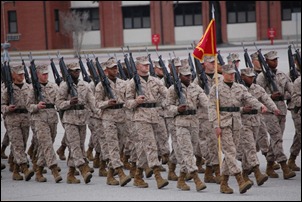 We ran back out to our bunks and put our civilian clothes back on and ran outside. We assembled in sort of a military formation and walked–because we didn’t know how to march–in that formation. It was still dark outside, but as we made our way over to the mess hall–now called a dining facility in the military, unfortunately–we could see other recruit platoons who had obviously been there a while. When they marched, it sounded like one heel: thump, thump, thump, thump. That was something. That might have been the only time the DIs let us gawk. Everything they did was as though they were one, in perfect unison. Everything we did was evidence that we had a long way to go. The DIs had a colorful way of telling us how far we had to go yet and whether they thought we had any chance of getting there.
We filed into the mess hall, and it was all business in there too. Once we got to the serving line and grabbed a tray, the mess men behind the serving line kept saying, “keep the chow line moving, privates, keep the chow line moving.” If the chow line stopped moving, there was trouble because the DIs saw that too. Of course, the yelling of “not fast enough,” “what are you looking at,” and “no talking” were echoing throughout the mess hall. I was near the end of the chow line, so I was one of the last to get my breakfast. That didn’t work out so well.
Thinking I should get a decent meal that morning so I would have enough battery juice to make it through the day, I grabbed some scrambled eggs, some hash browns, and a pastry. I should have stopped at the scrambled eggs and hash browns. I shoved that stuff in my mouth as fast as I could because almost as soon as I sat down, we were getting a countdown for when we needed to be finished. By the time we were told to get out of the mess hall, I still had that pastry sitting there. I started to get up, but one of those all-seeing DIs spotted that pastry on my tray.
He told me I wasn’t going to waste his Marine Corps chow. Everything seemed to belong to these DIs, and they seemingly took everything personally–my Marine Corps chow, my Marine Corps barracks, my Marine Corps dirt, my Marine Corps formation–and we seemed to always be messing up their Marine Corps things. In fact, they seemed to be convinced that we were there to destroy their Marine Corps and it was their mission to keep that from happening.
So, I was not going to waste his Marine Corps chow because doing so would lead to the demise of his Marine Corps. I dropped back down in my seat and my new shadow, the DI, was right on me yelling at me to get this thing eaten. I stuffed as much of that pastry in my mouth that I could–the proverbial ten pounds in the five-pound bag–and tried to chew, but it wasn’t going anywhere. It just seemed to get larger and mushier and more impossible to do anything with. I finally got the whole thing in my mouth and was still trying to chew it when he yelled at me (with his outside voice) to get out of there. I must have chewed that ball of grease and dough for an hour, but I finally got it down. That was the last pastry I ate in boot camp.
We got back to the barracks and cleaned the place up then went to get our uniforms. Once again, we became someone different (except for that red-headed guy). We looked nothing like Marines in those green uniforms though. It was pretty clear that we were just civilians dressed up–poorly, I should say–in Marine Corps uniforms. The uniforms smelled like mothballs and were dark green because they’d not yet been laundered. We looked terrible, but at least, in our eyes, we were starting to look like we belonged there.
 A little while later, we went to a place where we boxed up all of our personal belongings and shipped them home. The Marine Corps would issue to us anything we would need from that time on.
Then, we went over to the phone center where we were allowed to make a quick phone call home. There was a script taped next to the telephone that went something like this: “This is Recruit Doss. I have arrived safely at the Marine Corps Recruit Depot in San Diego. Please do not send me any food or bulky items in the mail. I will contact you in 3 to 5 days by postcard with my new address. Thank you for your support. Goodbye for now.”
That’s when it really settled on me that I now belonged to the United States Marine Corps. What happened from that time forward was entirely in the hands of a few drill instructors and what I was able to make of it. Every day presented a new challenge and produced more growth. It's interesting that as uncertain as I was about whether I could make it through boot camp before I arrived, once I got there, it never occurred to me again that I couldn't handle it. As much as I missed all that I left behind when I went to boot camp, it turned out that boot camp was what I needed to get on track.
Somehow, in three short months, they took us from raw recruits who needed yellow footprints painted on the ground to show us where to stand and turned us into Marines.
 So, I guess I just haven't been keeping up. I saw a movie the other evening for the first time in my life. I hadn't even heard of it, but I was sort of eavesdropping on the Turner Classic Movies station as the host - I think it was Robert Osborne - introduced the next feature saying that it was his favorite movie of all time. That got my interest up, so I paid some attention.
 Let me step aside again to say that Elizabeth Taylor was a very pretty woman back in the day. In this movie, she was 17-years old in real life and you could see that she was going to become the kind of woman that at least 7 guys would want to marry (8 if you count Richard Burton twice for the two times he married her).
 She arrived and phoned George and shamed him into agreeing to marry her. Unfortunately for all concerned, the courthouse was closed and they couldn't get married that day. So, George figured that since the courthouse was closed and he really didn't want to marry Alice anyway – especially with lovely Angela waiting in the wings – that he would just take Alice out boating in the middle of the night and drown her. It must’ve made sense to him at the time.


